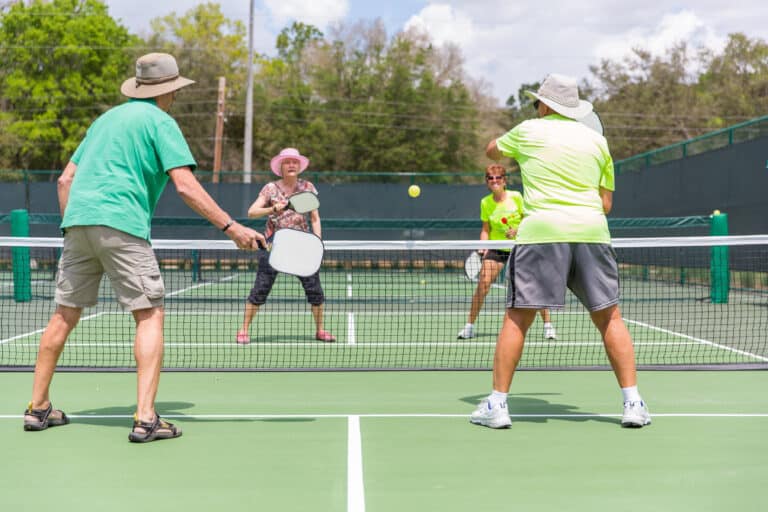

Pickleball Kitchen Strategy: How to Win More Points at the Non-Volley Zone
The kitchen is where pickleball gets interesting.
Officially, it is called the non-volley zone. Informally, everyone calls it the kitchen. Either way, it is the most important area on the court because so many points are won or lost there.
New players often think the kitchen is simply a place you are not allowed to stand. That is not true. You can stand in the kitchen. You just cannot volley the ball while you are in it. If the ball bounces, you can step in and hit it.
Understanding that difference changes how you play.

Why the kitchen matters so much
The team that controls the non-volley zone line usually controls the point.
When both players are established at the kitchen line, they can take time away from their opponents, cover angles, attack high balls, and keep pressure on the other team.
When one team is stuck back near the baseline, they are usually defending. They have more court to cover and less ability to create sharp angles.
That is why so much pickleball strategy is built around one goal: get to the kitchen line safely and keep your opponents from getting comfortable there.
For a broader rules refresher, see PickleballPit’s complete guide to pickleball rules and regulations.
Do not rush your way forward
Many players know they should get to the kitchen, so they sprint forward after every shot. That can be a mistake.
If you rush forward after a poor third shot, you may get caught in no-man’s land. That is the area between the baseline and the kitchen line where balls land at your feet and are hard to handle.
Move forward when your shot gives you time. If your drop is good, advance. If your drive forces a weak block, advance. If your shot is high and attackable, stop, prepare, and defend.
Good kitchen strategy starts with controlled movement.
Win the dink battle with patience
Dinking is not just tapping the ball over the net. It is a pressure game.
A good dink does three things:
It clears the net safely.
It lands in the kitchen.
It stays low enough that your opponent cannot attack.
Crosscourt dinks are especially useful because the court is longer on the diagonal. That gives you more margin and allows you to move your opponent.
Do not be in a hurry to speed the ball up. Many recreational points are lost because someone gets impatient and attacks a ball that is too low.
The goal of dinking is to create a mistake or earn a ball that is high enough to attack.
If you are still building consistency, start with the fundamentals in our guide to beginner pickleball tips before trying to speed up every ball.
Attack the right ball
Kitchen offense is not about hitting every ball hard. It is about recognizing the right ball.
A ball is attackable when it is high enough that you can hit forward or slightly downward. If the ball is below net level, be careful. Attacking from below the net usually sends the ball upward, which gives your opponent a chance to counter.
Look for these attackable balls:
A dink that floats too high
A weak reset
A ball left in the middle
A bounce that rises above the net
A player off balance or out of position
When you attack, keep the swing compact. At the kitchen line, a big backswing gives your opponent too much time to react and makes you more likely to miss.
Use the middle more often
One of the best places to attack in doubles pickleball is the middle.
The middle creates confusion. Both opponents may think the other player should take it. Even when they make contact, the return is often weaker because they are reaching or hesitating.
Middle attacks are also safer than extreme angles. If you miss wide, the point is over. If you attack through the middle with control, you keep pressure on your opponents without taking as much risk.
Keep your paddle ready
At the kitchen line, your paddle should be up and in front of your body. Not down by your knees. Not behind your hip. Not waving around after a big swing.
Think compact and ready.
After you hit, recover immediately. Many players hit a decent shot and then admire it. Better players hit and reset their paddle right away.
Speedups happen quickly. If your paddle is low, you are already late.
Respect the sideline
Sharp angles are part of kitchen play, but they can be overused. A dink that pulls your opponent wide is valuable. But if you go too sharp too often, you may miss wide or open up the court for a counter-angle.
Use wide dinks strategically. Move your opponent, then look for the next ball to attack through the middle or at their feet.
Communicate with your partner
Kitchen strategy is not only individual. It is also about partnership.
Talk before the point about who takes middle balls. In many teams, the forehand player takes the middle, but that can vary depending on positioning.
During the point, use simple words:
“Mine.”
“Yours.”
“Bounce.”
“Out.”
“Switch.”
Clear communication prevents hesitation, and hesitation loses points.
Know when to step into the kitchen
You can step into the kitchen after the ball bounces. This is important on short dinks.
If the ball lands short, step in, hit with control, and then get back out if needed. Do not stay trapped in the kitchen if the next ball may be volleyed.
A common pattern is: step in, dink, step back.
The key is balance. If you lunge into the kitchen and cannot recover, your opponent may attack the next ball.
USA Pickleball’s official rulebook explains the non-volley zone rule in detail: USA Pickleball Rules
The bottom line
The kitchen is not just a rule area. It is the main battleground of pickleball.
To win more points at the non-volley zone, be patient, keep the ball low, attack only the right balls, use the middle, and stay ready for counters.
The best kitchen players are not reckless. They are calm, balanced, and disciplined. They wait for the point to come to them instead of forcing a shot that is not there.